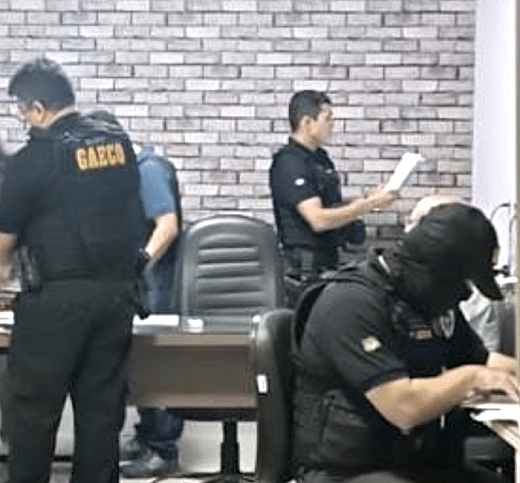
The serious financial crisis faced by Várzea Grande City Hall gained a new chapter this Tuesday (28), with the official installation of the technical table of the Mato Grosso Court of Auditors (TCE-MT), created to discuss legal and financial alternatives to face the municipality's court debt, which is already approaching R$ 1.2 billion.
Flávia Moretti cries when reporting a billion-dollar crisis and admits cuts to the public sector to face court-ordered debt
The serious financial crisis faced by Várzea Grande City Hall gained a new chapter this Tuesday (28), with the official installation of the technical table of the Mato Grosso Court of Auditors (TCE-MT), created to...
During a press conference held after the meeting, Mayor Flávia Moretti became emotional when describing the scenario of fiscal collapse faced by the administration. Amid the outburst, he stated that he had already had to decide between paying court orders, paying civil servants' salaries or guaranteeing the purchase of medicines to supply the public health network. He also recognized that, if a solution is not found, harsh measures, such as downsizing the public sector and even dismissals, may be necessary.
The meeting was led by the president of TCE-MT, counselor Sérgio Ricardo, and was attended by counselor Antônio Joaquim, as well as representatives from the Court of Justice, Public Prosecutor's Office, Municipal Attorney General's Office and technical teams. The objective is to build an institutional solution to a problem considered historical and which, according to the participants, goes beyond current management.
When opening the press conference, Flávia explained that the technical panel has already started a detailed analysis of the public accounts.
"Today the technical table was definitively installed to deal with the issue of court orders in Várzea Grande. But it wasn't just the installation. We have already started a big debate on the budget, revenues, expenses and mandatory transfers. Now, the technicians will study the entire financial situation of the municipality so that we can find a solution to this debt", he stated.
According to the mayor, consolidated liabilities are already close to R$1.2 billion and continue to increase daily due to monetary updates determined by the National Council of Justice (CNJ).
She attributed the growth in debt to the accumulation of court orders over several administrations.
"Today we are partially paying a court order from 1988. This process alone represents around R$190 million. Furthermore, approximately half of this debt is linked to the DAE, mainly due to electricity bills that have stopped being paid since the time of the old Cemat. We also have food allowances, compensation, civil servant terminations and several other court orders that have been accumulated over the years."
Flávia explained that the situation worsened after changes promoted by the Constitutional Amendment approved in 2025, which began linking the payment of court orders to the Net Current Revenue (RCL) of the municipalities.
According to her, when she took over as mayor, she found a debt of approximately R$22 million relating to the previous year. Shortly afterwards, the new rule significantly increased the mandatory amounts of monthly installments.
At the same time, Várzea Grande suffered a reduction in revenue from constitutional transfers, especially due to the drop in the participation rate in the Municipal Participation Fund (FPM) and the decrease in ICMS collection.
"The municipality lost revenue precisely at the time when its payment obligation increased. The account simply doesn't add up."
Another factor that worsened the crisis, according to the mayor, was the decision of the Superior Court of Justice (STJ) that transferred responsibility for paying court orders from the Department of Water and Sewage (DAE) to the City Hall.
"According to the decision of the Superior Court of Justice, today the City Hall is the one paying the DAE court orders. The Department no longer pays. All this responsibility has passed to the municipality."
She compared the amounts disbursed in previous years with the current ones.
"In 2023, around R$700,000 were paid per month. In 2024, the largest payment was approximately R$2.5 million. Today our fixed installment reaches R$6.4 million per month."
Despite the difficulties, Flávia stated that her administration has already allocated approximately R$40 million to the payment of court orders in 2025. With the recent judicial blockades, the total disbursed could reach R$80 million by the end of the year.
"What I paid this year already exceeds everything that was paid in the previous administration. But the debt is a snowball. It was never really addressed and continues to grow."
The most striking moment of the press conference occurred when the mayor, emotionally, reported the dilemmas faced daily by the municipal administration.
"There was a month when I had to choose between paying court orders, paying salaries or buying medicines to supply the health system. This is the reality we face."
Asked about the immediate effects of the installation of the technical table, Flávia stated that there has not yet been any decision suspending the judicial blocks on City Hall's accounts.
"Anything could happen. We left here without any decision to suspend the arrest. We still have no guarantee."
When asked about the possibility of cuts in civil service, the mayor responded that the scenario remains under analysis.
"The downsizing of the machine could happen. I can't say that there will be layoffs, but I also can't say that this is ruled out."
During the meeting, counselor Antônio Joaquim highlighted that the role of the Court of Auditors is not to interfere in the Executive's administrative decisions, but to seek a legal solution to a problem that affects several municipalities in Mato Grosso.
"The Court of Auditors does not enter into management to say whether the mayor should resign or not. Our mission is to discuss the constitutional problem of court orders. This did not arise yesterday. It is a debt built up over many years because several managers simply stopped paying."
According to the counselor, the tightening of the rules occurred precisely after successive failures to comply with judicial obligations by municipal administrations.
“That was exactly why the so-called ‘PEC
Source: Nortao News
Next recommended read
This story was originally published by Nortao News. Visit the original publication for further details.
Open original publication