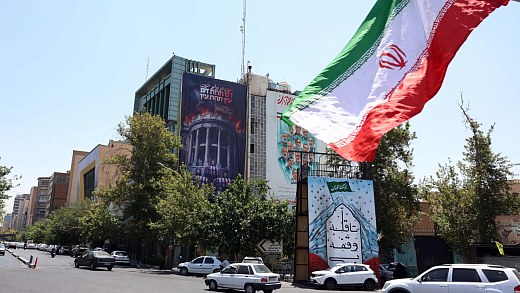
SÃO PAULO, SP (UOL/FOLHAPRESS) - The public funeral of Ali Khamenei, supreme leader of Iran, begins tomorrow, four months after his death, which occurred on February 28 following attacks by the United States and Israel. The leader's body remained refrigerated for the ceremony.
How was Ali Khamenei's body preserved even four months after his death?
SÃO PAULO, SP (UOL/FOLHAPRESS) - The public funeral of Ali Khamenei, supreme leader of Iran, begins tomorrow, four months after his death, which occurred on February 28 following attacks by the United States and Israel....

WHAT IS BODY CONSERVATION LIKE?
Islamic burial practices generally prohibit chemical embalming. Due to this restriction, Iranian authorities resorted, according to the Hindustan Times, to so-called "cold storage" instead of chemical preservation products.
Khamenei's body was kept inside refrigerated forensic morgues under freezing conditions. The facilities are equipped with high-capacity, low-temperature refrigeration chambers, which allows bodies to be preserved for months without chemical embalming.
"Iran's forensic morgues already hold bodies for months, so four months in freezing is not exotic. That's what 'religious and legal standards' cover," Counterterrorism expert Mohammed Omar told Fox News Digital.
The funeral ceremony for Khamenei, who died at the age of 86, only began yesterday. It will span several cities in Iran and Iraq before his burial in Mashhad, his hometown, on July 9.
Khamenei was not the only victim, and several of his family members were also killed during the attack. Iranian authorities preserved their bodies along with his in the same storage facilities while funeral preparations continued.
WHY DID THE FUNERAL TAKE SO LONG?
According to Islamic custom, burial should take place as quickly as possible, ideally within 24 hours of death. This was not possible in Khamenei's case for security reasons, as Iran had been facing continued military attacks from the US and Israel.
The delay was also shaped by logistical considerations. Iran has witnessed deadly crowd-related incidents during large state funerals, such as that of former supreme leader Ruhollah Khomeini in 1989, when incidents of crowd crushing disrupted burial procedures.
Officials spent months creating a strictly controlled security and movement plan. Millions are expected to attend Khamenei's funeral.
Although delayed burial is uncommon in Islam, exceptional circumstances may permit it. Shia religious jurisprudence allows for the postponement of burial when war or serious security threats make immediate burial unsafe or impossible. This allowed Iranian authorities to obtain the necessary approval to preserve the body until conditions improved.
FAREWELL PROGRAMMING
Iran yesterday held the first farewell ceremony with the body of Ali Khamenei. The program begins with public viewings on Saturday and Sunday in Tehran, and a funeral procession is scheduled for Monday - authorities estimate the attendance of 15 to 20 million people. Another procession is planned for the following day in Qom, one of the holy cities of Shiite Islam.
According to Iran International, Tehran is also preparing a massive security operation for the funeral. "The Basij [paramilitary militia] and the IRGC [Islamic Revolutionary Guard Corps] running this is not a detail. The Basij [paramilitary militia] is coordinating the logistics - highways turned into parking lots, each district of Tehran assigned to a province, five public holidays declared - and the Guard handles crowd control," explains Mohammed.
SUCCESSION IN IRAN
Mojtaba Khamenei took over as the new supreme leader. Son of Ali Khamenei, he became the third supreme leader of the Islamic Republic, a position created after the 1979 Islamic Revolution.
He has not appeared in public since the start of the war. According to the Reuters news agency, Mojtaba was seriously injured in the attack that killed his father. His public absence comes amid the regime's efforts to demonstrate stability following Khamenei's death.
The funeral will also be observed as a political test for Mojtaba. The Telegraph claims the ceremony could be an opportunity for the new supreme leader to consolidate his authority. The publication says that his eventual presence at the funeral prayers will be seen as a sign of how much he intends to expose himself publicly.
Read Also: Negotiations between US and Iran will resume after Ali Khamenei's funeral
Source: Noticias ao Minuto - Mundo
This story was originally published by Noticias ao Minuto - Mundo. Visit the original publication for further details.
Open original publication