Former federal deputy Eduardo Bolsonaro (PL-SP) suggested that Federal Supreme Court (STF) minister Alexandre de Moraes once again be the target of sanctions provided for in the Magnitsky Law following the decision that suspended visits by senator Flávio Bolsonaro (PL-RJ) to former president Jair Bolsonaro (PL), who is under house arrest.
Eduardo asks Magnitsky to return after Moraes suspends Flávio's visits to Bolsonaro
Former federal deputy Eduardo Bolsonaro (PL-SP) suggested that Federal Supreme Court (STF) minister Alexandre de Moraes once again be the target of sanctions provided for in the Magnitsky Law following the decision that...
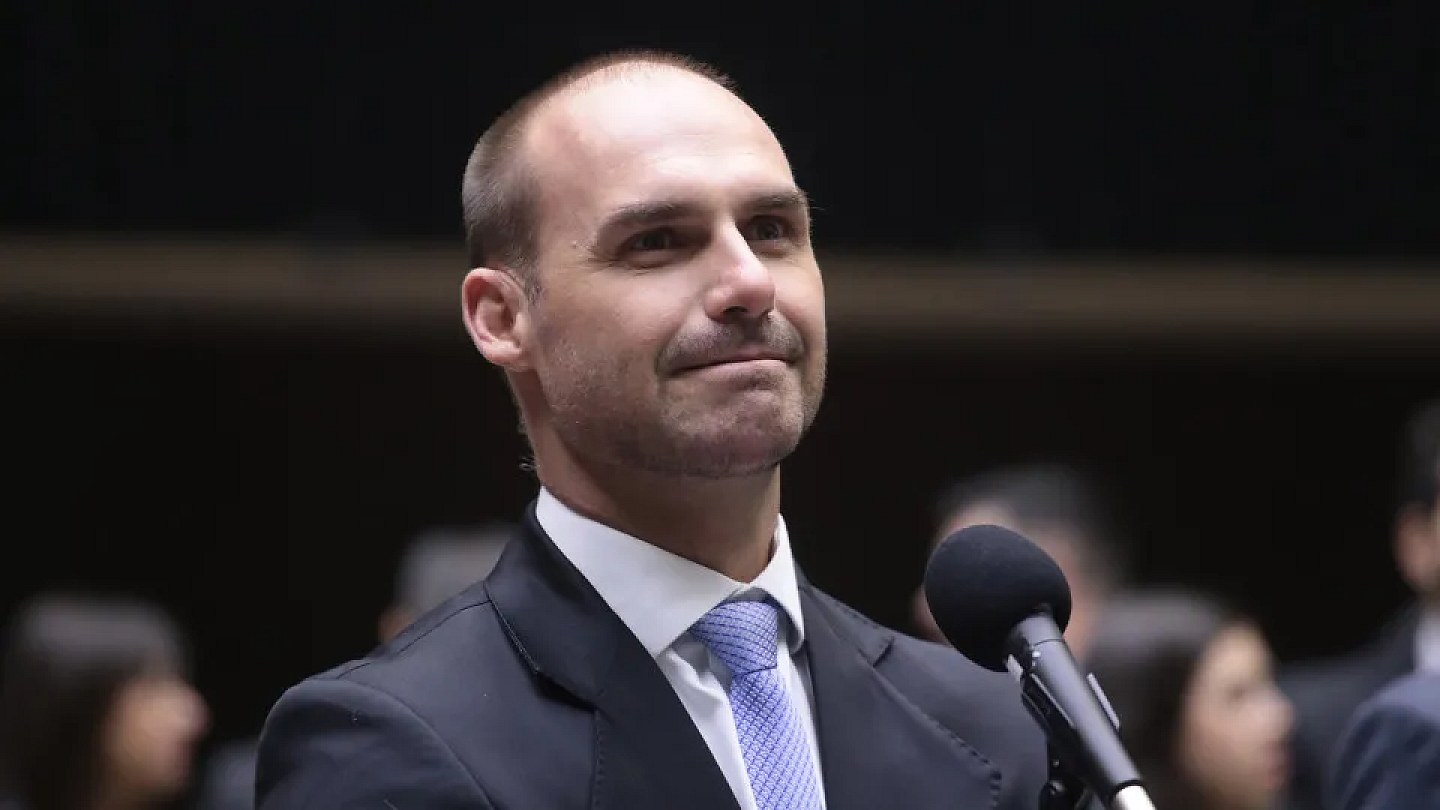

In a post on social media on Monday night, the 13th, Eduardo also stated that, due to the ban on visits, other countries should not recognize the Brazilian presidential elections as democratic.
"If in an entire country just one prisoner is prohibited from communicating with his son - and presidential candidate - for political reasons, this election should not, in advance, be recognized as democratic by free countries. The Magnitsky sanction against the minister of the Federal Supreme Court of Brazil, Alexandre de Moraes, must be reestablished," he wrote.
The restriction on visits was determined by Moraes after Flávio published a letter written by his father on social media to endorse his candidacy for President. In the document, Jair Bolsonaro calls for his supporters to unite for his senator son and presents him as his "spokesman" and "the best option to rid Brazil of corruption, violence and impoverishment." Flávio will not communicate with the former president for 90 days, until after the first round.
Moraes also ordered the case to be sent to the electoral attorney general, Paulo Gonet, to determine whether the conduct constitutes early electoral propaganda by Flávio. For the minister, the letter was an instrument of political promotion of his son's candidacy for President, "with a semantic load equivalent to an explicit request for a vote".
When defending the resumption of sanctions against the minister, Eduardo Bolsonaro cited the Magnitsky Law, created by the United States government to impose financial and administrative restrictions on people accused of corruption or human rights violations. Those affected may face blocking of assets and bank accounts in the USA, in addition to having their visa canceled and being banned from entering the country.
Alexandre de Moraes was included in the list of those sanctioned in July last year, under the justification that he was promoting an "illegal witch hunt" against Jair Bolsonaro and undertaking a "censorship campaign". He was the rapporteur of the process that sentenced the former president to 27 years and three months in prison for an attempted coup d'état. The measures against Moraes were revoked in December.
Eduardo Bolsonaro's actions in the USA to provoke actions by American authorities led to his conviction by the STF, in June this year, for coercion during the process. In an action reported by Moraes, the First Panel voted to sentence the former deputy to four years and two months in prison, in a semi-open regime, a fine of R$ 165 thousand and ineligibility for eight years.
The Federal Public Defender's Office, which represents Eduardo since he did not appoint a lawyer, is trying to reduce his sentence in an appeal presented to the Court last week.
Read Also: Damares defends Michelle, calls for an end to attacks and says that Flávio is 'still' his pre-candidate
Source:
Noticias ao Minuto - Ultima Hora