(FOLHAPRESS) - The City of São Paulo has been charged, at the federal level, to control the advancement of urbanization in the main neighborhoods affected by noise from Congonhas, Campo de Marte and Guarulhos airports. Attempts at reconciliation have been going on since at least 2018, but gained strength with the expansion works on aerodromes, the intense verticalization and the mobilization of residents against noise.
SP City Hall ignores federal rule to contain urbanization in areas with airport noise
(FOLHAPRESS) - The City of São Paulo has been charged, at the federal level, to control the advancement of urbanization in the main neighborhoods affected by noise from Congonhas, Campo de Marte and Guarulhos airports....
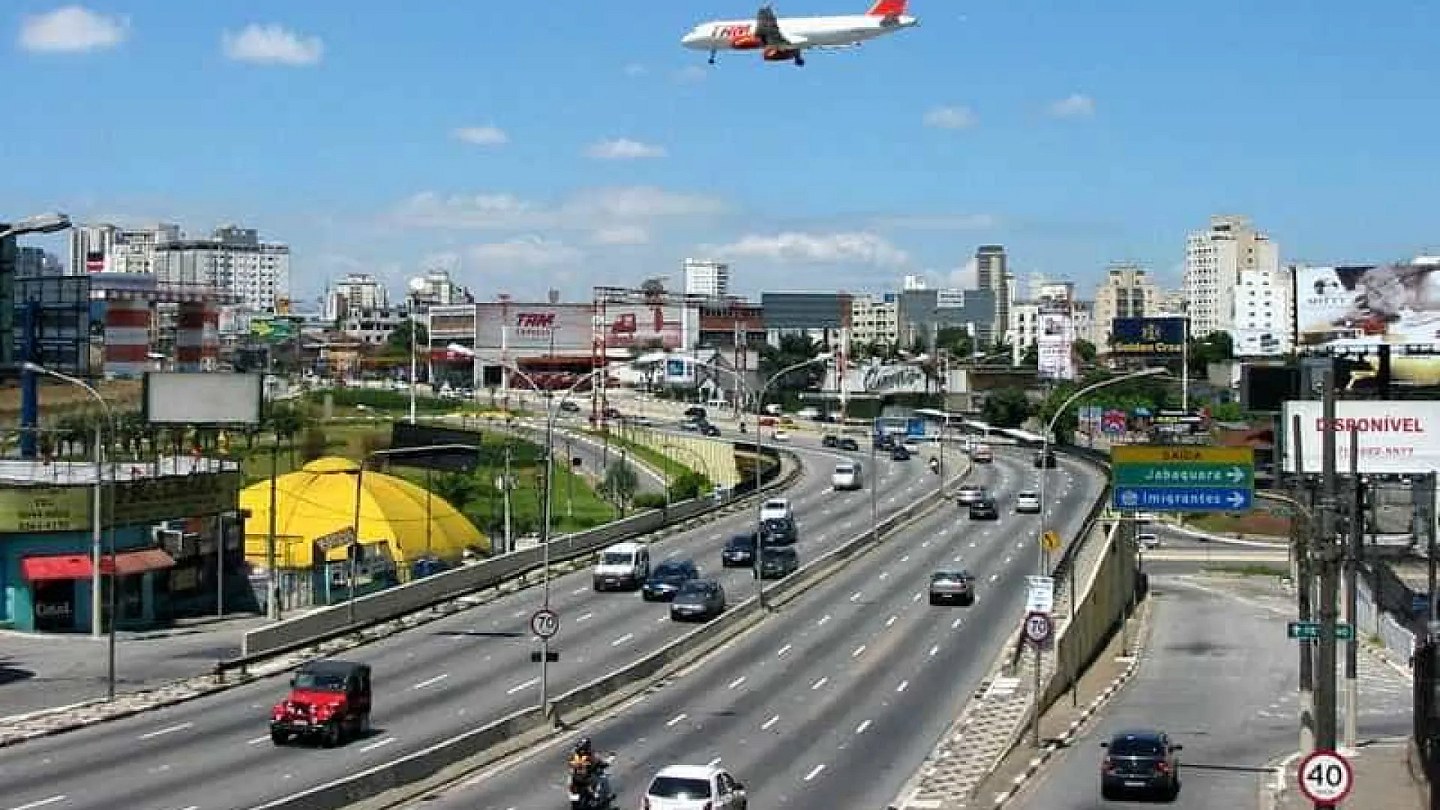
On June 30, the Ricardo Nunes (MDB) management published a resolution determining that owners and developers be notified if the property is located in an area subject to weighted average aeronautical noise from 65 decibels, a level considered incompatible with residential use without acoustic reinforcement. The measure is for informational purposes only and does not impose restrictions or sanctions.
The main demand made by Anac (National Civil Aviation Agency), Infraero (Brazilian Airport Infrastructure Company) and the MPF (Federal Public Ministry) is for the city hall to incorporate the PEZR (Specific Noise Zoning Plan) for airports into urban legislation.
The change would imply greater requirements or restrictions for new construction, such as the adoption of more efficient acoustic insulation. The obligation is provided for in the Brazilian Aeronautics Code of 1986.
In a public hearing held last Thursday, 16th, at Alesp (Legislative Assembly of São Paulo), a representative from Anac made an appeal for the incorporation of PEZR.
"It is a legal and constitutional obligation that has not yet been fulfilled. Without compatibility, there is no control over densification around the aerodrome", stated Alfredo Isaac Nogueira, a specialist in regulation in the area.
In a note, the city council responded to Folha that it has been adopting measures against airport noise, such as the informative resolution and the future inclusion of PEZRs on the city's digital map, “increasing transparency and facilitating access for the population”.
In conciliation meetings at TRF-3 (Federal Regional Court of the 3rd Region), the municipal administration also indicated that it may include airport noise in discussions on the review of the Master Plan and the Zoning Law, scheduled for 2029.
Representatives of federal agencies claim that São Paulo has allowed urban occupation around airports to worsen for decades. In 2024, the MPF indicated that it could file an action to force the incorporation of PEZR if conciliation did not progress.
Experts defend the need to control urbanization both to protect the health of the population and to prevent the growth of occupation from causing new restrictions on airports. Currently, Congonhas remains closed to flights between 11pm and 6am, with exceptions.
The most affected perimeter has 11,600 lots. City hall survey, carried out in 2022, shows that 11,642 lots are affected by airport noise above 65 decibels.
The report was prepared by a working group on airport noise zoning, formed by the municipal departments of Urban Planning and Licensing, Green and Environment, Government and Subprefectures.
Most of the lots are around Congonhas: there are 10,513, with 35,652 contributors. The affected area totals 6.2 km² and is distributed across the districts of Moema, Itaim Bibi, Jabaquara, Campo Belo and Saúde, in the south zone.
Of the total, 84.35% are in blocks of mostly residential or mixed use. The region also has three hospitals, two health centers and 12 public schools, in addition to other equipment.
In Campo de Marte, the most affected area totals 1.55 km², with 402 lots, of which 84.33% are in blocks of predominantly residential or mixed use.
There are 482 taxpayers in the districts of Santana and Casa Verde, in the north zone.
There are also residents of the Jaçanã district, also in the north, affected by Guarulhos airport. They are spread over an area of ??0.35 km², with 727 lots and 826 contributors. Around 80% of the properties are located in blocks of predominantly residential use.
In the last three years, noise complaints in Congonhas have more than doubled. There were 69 registrations in 2023, 116 in 2024 and 160 last year, according to Aena's annual report.
Although growing, the discussion about construction density around the capital's main airport is not new. In 2006, the city council considered imposing restrictions after a study showed that the area affected by noise had increased by 117% in 20 years.
Currently, part of the area around the aerodromes is zoned practically restricted to housing. There are also municipal incentives for the construction of apartments in blocks close to bus lanes and subway lines, such as 5-Lilás and 17-Ouro, which tends to increase housing growth.
The final report of the city hall working group recommended that the topic be debated during the review of the Zoning Law, which did not happen.
The document also indicated the discussion of new acoustic insulation requirements for renovations, demolitions, constructions and other interventions, in addition to carrying out studies on the impacts of airports and the characteristics of neighboring areas.
Paris was the first city to incorporate noise curves into urban legislation, in 1965. More recently, Guarulhos and Curitiba also included PEZR in their local laws, among other cities.
Congonhas can have a tolerable level with acoustic reinforcementCoordinator of the Transport and Logistics Engineering course at UFSC (Federal University of Santa Catarina), Renata Cavion mapped that around 70.3% of the blocks included in the Congonhas PEZR had uses incompatible with the noise level in 2024.
She assessed, however, that acoustic reinforcement measures could make the situation tolerable in 82.6% of the most problematic area.
Also vice-president of SBTA (Brazilian Society for Air Transport Research), the expert states that public authorities could be inspired by the policies adopted by the Netherlands for areas prone to flooding:
Source: Noticias ao Minuto - Ultima Hora
This story was originally published by Noticias ao Minuto - Ultima Hora. Visit the original publication for further details.
Open original publication