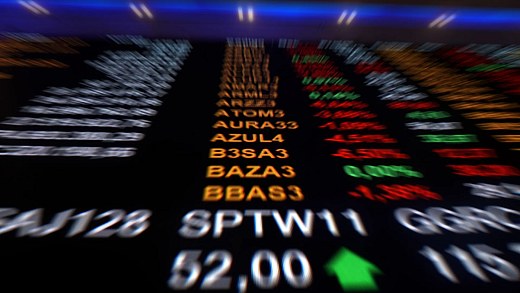
Understand what makes the price of the dollar rise or fall The dollar opened this Wednesday's session (22) on a high, with an increase of 0.17% close to 9 am, quoted at R$ 5.0816. Investors evaluate the new tariff imposed by American President Donald Trump and await new corporate results. Ibovespa trading, the main index on the Brazilian stock exchange, begins at 10am. ?? Do you have any reporting suggestions? Send it to g1 ?? The new 25% additional tax imposed by Trump on Brazilian products will be on the radar this Wednesday. The tariff came into force yesterday and the expectation is that a new rate, which should be between 10% and 12.5%, will be announced soon for around 60 trading partners, including Brazil. The measure also puts pressure on the Brazilian government, which is still talking to businesspeople in the affected sectors and evaluating how to react to the taxation. ?? Furthermore, the conflict in the Middle East and the decreasing number of vessels that are able to cross the Strait of Hormuz are also on the radar. Despite mediators calling for a ceasefire between the United States and Iran to hold negotiations, the attacks continue. Tensions continue to be reflected in oil prices, amid fears of a disruption in global supply of the commodity. Around 9 am, a barrel of Brent, an international reference, had increased by 4.41%, quoted at US$ 95.02. West Texas Intermediate (WTI), from the USA, rose 4.07% at the same time, quoted at US$ 87.77 per barrel. READ MORE Oil surpasses US$95 for the first time since June after the escalation of the war between the US and Iran See below for more details from the day in the market. ?Dollar
Dollar opens higher, with an eye on new Trump tariffs and corporate results
Understand what makes the price of the dollar rise or fall The dollar opened this Wednesday's session (22) on a high, with an increase of 0.17% close to 9 am, quoted at R$ 5.0816. Investors evaluate the new tariff...

a Accumulated for the week: -0.75%; Accumulated for the month: -1.74%; Accumulated for the year: -7.57%. ?Ibovespa
Accumulated for the week: --0.22%; Accumulated for the month: +0.76%; Accumulated for the year: +7.57%. Tariff comes into effect The additional tariff of 25% from the United States on part of Brazilian products exported to the country comes into force this Wednesday (22). The measure was announced after an investigation by the Donald Trump administration concluded that Brazil adopts practices that "encumber or restrict" trade with the USA. Examples cited include the PIX payment system and the regulation of digital platforms. The justifications were widely contested by the Brazilian government, which considers the measure an attempt to interfere in internal issues that are considered non-negotiable. The assessment in Brasília is that the tariff is politically motivated. The new tax leaves out an extensive list of products, including oil, coffee and beef. On the other hand, sectors such as ethanol, agricultural machinery and paper will be affected by the measure. READ MORE See questions and answers about Trump's new tariff The government is still studying how to react to taxation What are the risks and gains if Brazil adopts reciprocity? Understand why Brazil avoids immediate retaliation Oil and tensions in the Middle East In the early hours of this Wednesday, Iranian time, the USA attacked Iranian targets for the 11th consecutive night. According to American forces, the bombings hit Iranian command centers, air defense systems, missile launchers and drones. Residents of Tehran reported explosions. Others were recorded in the cities of Chabahar, Konarak and Bushehr, where Iran's only nuclear power plant is located. Previously, Iran had attacked US military installations in Bahrain, Kuwait and Jordan. Additionally, an oil tanker was hit in the Strait of Hormuz, at the entrance to the Gulf. Iran also claimed to have hit Amazon infrastructure in Bahrain, where the American company maintains a regional data center. The company did not comment. Also on Tuesday, the President of the United States, Donald Trump, stated that he could attack "very soon" Pickaxe Mountain, close to the Natanz nuclear facility. The mountain is home to a network of underground tunnels where experts believe Iran maintains part of the infrastructure used in uranium enrichment. In response, the Iranian military command stated that it will attack investments from the United States and allied countries if Iranian nuclear facilities are bombed. According to an Iranian Health Ministry official, 50 civilians were killed and 500 injured in recent US attacks. The US has confirmed the deaths of 18 soldiers since the start of the war. The escalation of tensions once again raises concerns about the Strait of Hormuz, one of the main maritime routes for global oil transport. What is the Strait of Hormuz, fundamental for world oil Global stock markets In Asia, Chinese shares closed lower this Wednesday, once again led by the chip and technology sectors, as investors took profits after the previous session registered the biggest increase in three months. The CSI 300, which brings together the largest companies listed in Shanghai and Shenzen, fell 0.46%, while the Shanghai composite index, the SSEC, rose 0.07%. Among the other exchanges in the region, Hong Kong's Hang Seng fell 0.95%, while South Korea's Kospi rose 0.74% and Japan's Nikkei fell 0.18%. *With information from Reuters news agency. Dollar exchange rate shows less confidence in the Brazilian economy due to government spending and debts Jornal Nacional/ Reproduction
This story was originally published by G1 Economia. Visit the original publication for further details.
Open original publication