(FOLHAPRESS) - The video made with artificial intelligence in which Jair Bolsonaro declares support for his son Flávio Bolsonaro's candidacy, shown at the PL national convention on Saturday (25), could lead to the investigation of possible non-compliance with the restrictions imposed on the former president by the STF (Supreme Federal Court).
AI video only violates house arrest if Bolsonaro participated or consented, says lawyer
(FOLHAPRESS) - The video made with artificial intelligence in which Jair Bolsonaro declares support for his son Flávio Bolsonaro's candidacy, shown at the PL national convention on Saturday (25), could lead to the...
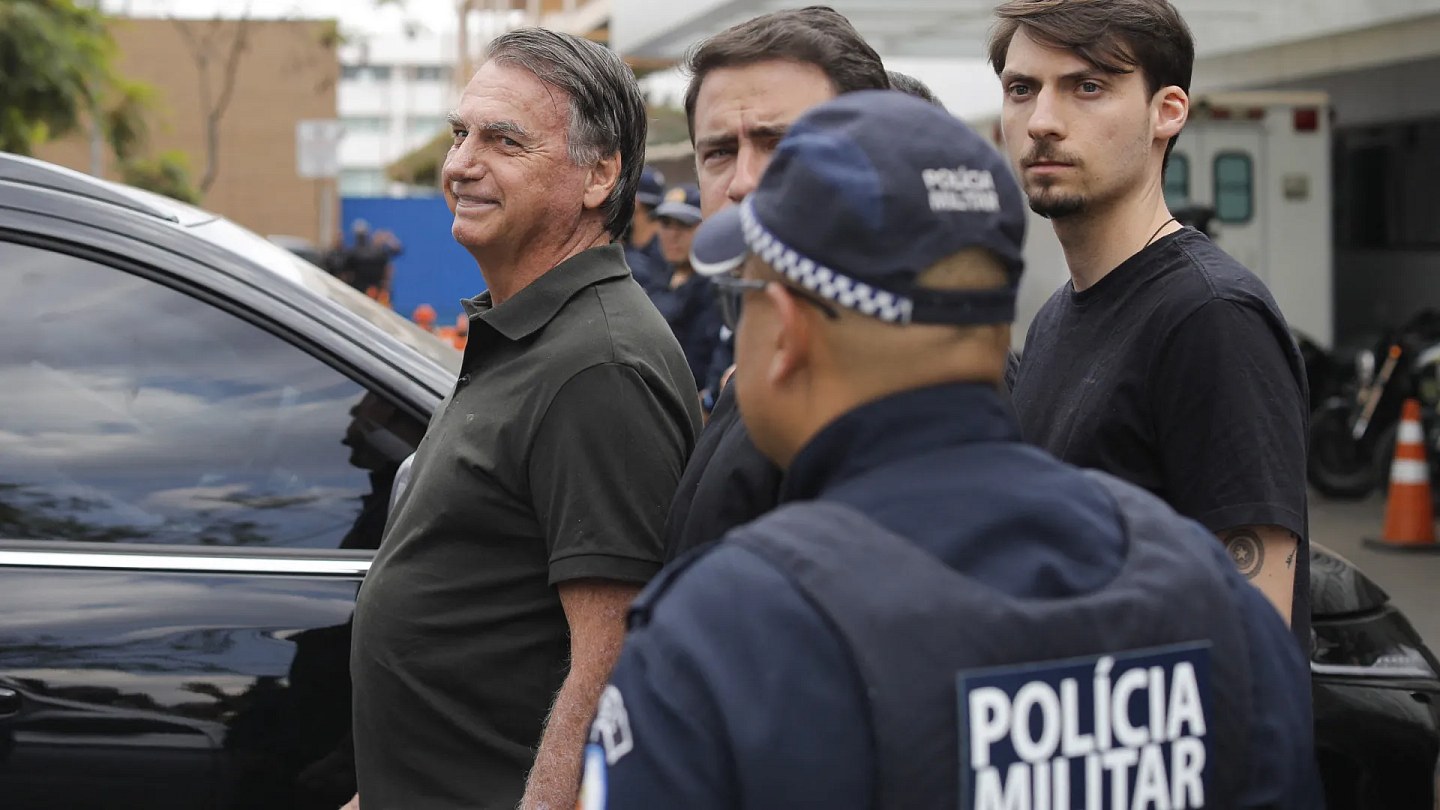
Liability will depend on evidence that Bolsonaro participated in or authorized the message, in the opinion of criminal lawyer Jhonatan Fernando Ferreira.
Shown on the convention's big screen, the piece reproduced Bolsonaro's image and voice, saying he was "trapped and silent" due to an "unfair and arbitrary" decision and asked those present to welcome Flávio as "the person I chose to replace me".
The PGR (Attorney General's Office) was called to investigate the video. PT parliamentarians say that the piece may have been used to circumvent restrictions imposed by the STF.
Flávio was moved when he watched the video and, in a speech, stated that his father was persecuted and the victim of the "biggest hoax" in the country's history. The convention, held at Mercado Livre Arena Pacaembu, in São Paulo, made the senator's candidacy for President of the Republic official.
As the Panel showed, federal deputy Dandara (PT-MG) asked the PGR to investigate the exhibition of the play. In the letter, she states that the video could constitute irregular electoral propaganda and an electoral crime, in addition to mentioning the suspension of Bolsonaro's political rights.
Representative Lindbergh Farias (PT-RJ) also called the PGR against Flávio. According to him, the use of artificial intelligence sought to circumvent the restrictions imposed on the former president. The parliamentarian also argues that the warning that it was a simulation does not rule out a possible irregularity.
For lawyer Jhonatan Ferreira, the use of a synthetic image is not enough, in itself, to characterize non-compliance with the conditions of house arrest. “The former president would have to have effectively participated or consented,” he says.
The situation would be different if the piece contained criminal content, such as incitement against the polls or an attack on the democratic rule of law, according to him.
The discussion comes after an episode earlier this month, when Flávio read a letter written by Bolsonaro on social media. In it, the former president presented his son as spokesman and candidate chosen to represent him politically.
After the announcement, Moraes suspended Flávio's visits to his father for 90 days. The minister stated that the senator failed to comply with the precautionary measure that prohibits Bolsonaro from using social media, directly or indirectly.
According to Moraes, Flávio had used "expressions with a semantic load equivalent to an explicit request for a vote" and classified the disclosure as an "instrument of political promotion". For the minister, the senator's call before the reading indicated that Bolsonaro knew about the disclosure.
The defense denied prior knowledge of the publication. Moraes rejected the justification and stated that neither Bolsonaro nor Flávio could claim ignorance of the ban.
In addition to the criminal front, the video opens up electoral debate. The piece can be classified as "deepfake" - a technique that uses digital resources to simulate or alter images and voices, prohibited by the TSE when used to favor or harm candidates.
The convention took place before August 16, when electoral propaganda officially begins. Before this date, pre-candidates can announce that they intend to compete, present proposals and extol their own qualities or those of their allies, as long as they do not make an explicit request for a vote.
Therefore, there is discussion about whether the TSE's rule against "deepfakes" also applies to partisan acts carried out before the official start of the campaign.
The video informs, right at the beginning, that it was produced with artificial intelligence. For Ferreira, the notice complies with electoral rules by making it clear that Bolsonaro did not record the message.
Diogo Rais, professor of electoral and digital law, states that identification reduces the possibility of deception, but considers that a literal reading of the TSE resolution may still consider the use of synthetic image and voice to favor a candidacy to be irregular.
TSE Resolution 23,610 prohibits, in electoral propaganda, the use of synthetic audio or video content to create, replace or alter the image or voice of a living, dead or fictitious person to favor or harm a candidacy. The text says that the prohibition applies “even if subject to authorization”.
The provision also provides that non-compliance may constitute abuse of political power and misuse of social media.
The TSE has classified the prohibition of "deepfake" as absolute, as it understands that the technique can mislead voters and affect the integrity of the election.
In Rais' assessment, the video shown by PL combines the use of AI and the reproduction of a person's image and voice, but not necessarily the dissemination of false or misleading content. This is because the piece identifies itself as a simulation. Furthermore, Bolsonaro's support for his son had already been expressed in a letter read by Flávio.
PL launches Flávio Bolsonaro's candidacy for President
The event was held at Mercado Pago Hall, at Arena Pacaembu. The gates opened at 8:30 am, but the convention only started around noon, with a speech by the PL's national president, Valdemar da Costa Neto.
Source: Noticias ao Minuto - Ultima Hora
This story was originally published by Noticias ao Minuto - Ultima Hora. Visit the original publication for further details.
Open original publication