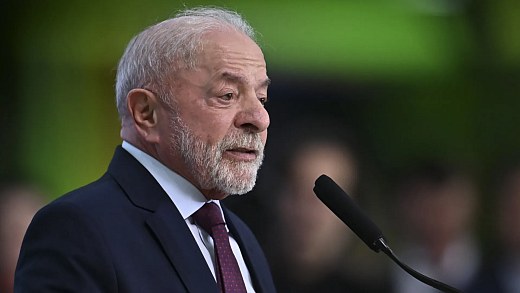
US Trade Representative, Jamieson Greer, speaks to the press on the day he participates in a working lunch with EU trade ministers, in Brussels, Belgium, November 24, 2025. Piroschka van de Wouw/Reuters The representative of the United States Department of Commerce, Jamieson Greer, stated on Thursday (9) that the decision on a new tariff on Brazilian imports will be announced "very soon", but said that the two countries are still far from reaching an agreement. "I've been talking to the Brazilians. We've been trying to negotiate. I think there's still a considerable distance between us. That's why you'll see a final decision on Brazil very soon, because we have a legal deadline of July 15," Greer said in an interview with Fox Business Network. On June 1, Trump proposed 25% tariffs on Brazilian goods, after an investigation into different topics, such as illegal deforestation, piracy and PIX. The following day, he announced additional fees of 12.5% ??for 60 countries for failures to combat forced labor, including Brazil. In both cases, a long list of exceptions was presented to prevent a price rise in the American market. Itamaraty maps more than 40 American companies and associations that do not want the tariff Itamaraty maps more than 40 American companies against tariffs The impact on Brazil and the USA On Monday (6), the USTR opened the public hearings phase of the investigation. Participation is open to interested parties who register. Representatives of Brazilian and American associations from various sectors participated in the hearings, such as coffee, rice, sugar, corn ethanol, pig iron, ornamental rocks, wood, paper, footwear, honey and intellectual property. For the president of the American Chamber of Commerce for Brazil (Amcham), Abrão Neto, "the application of new tariffs would be harmful to both economies, with negative impacts on the productive sector and consumers in the United States, in addition to the loss of competitiveness of Brazilian exports to a crucial market”. Neto also mentioned that the United States' share of Brazil's total trade fell to 11.2% in the first five months of 2026, the lowest level ever recorded. Brazilian imports from the United States also fell 11% in the same period. "These trends suggest that additional tariffs could further reduce the U.S. commercial presence and economic influence in one of the world's largest emerging markets, opening space for foreign competitors to expand their market share at the expense of American companies," he added. As Ana Flor's blog showed, representatives of companies that participated in the hearings believe that the adoption of new tariffs is practically inevitable. The expectation, however, is that the scope of the measure can be calibrated according to its impacts on the American economy. One of the main arguments presented is that making the import of Brazilian products more expensive could increase the dependence of United States production chains on inputs and components from China, an effect that goes against the Donald Trump administration's trade strategy.
Decision on tariffs for Brazil will come 'very soon', says US trade representative
US Trade Representative, Jamieson Greer, speaks to the press on the day he participates in a working lunch with EU trade ministers, in Brussels, Belgium, November 24, 2025. Piroschka van de Wouw/Reuters The...

Source: G1 Economia
This story was originally published by G1 Economia. Visit the original publication for further details.
Open original publication