Around 15.2 million people live in the area of ??the planet where it will be possible to observe the total solar eclipse this Wednesday (12), according to an estimate from the specialized website Time and Date. The number reaches approximately 980 million, or 12% of the world's population, when the regions where the phenomenon will be partially seen are also considered.
Solar eclipse will darken the sky for 15 million people around the world
Around 15.2 million people live in the area of ??the planet where it will be possible to observe the total solar eclipse this Wednesday (12), according to an estimate from the specialized website Time and Date. The number reaches...
The band of totality passes through Greenland, Iceland, northern Russia, Spain and a small area of Portugal. The partial phase can be seen in much of Europe, in addition to areas of North America, northern Asia and northern and western Africa.
- In Brazil, however, the eclipse will not be visible, not even partially.
- The phenomenon happens when the Moon passes between the Sun and the Earth, projecting its shadow over the planet.
Editorial reading aid based only on information contained in this story and its identified source.
The band of totality passes through Greenland, Iceland, northern Russia, Spain and a small area of Portugal. The partial phase can be seen in much of Europe, in addition to areas of North America, northern Asia and northern and western Africa. In Brazil, however, the eclipse will not be visible, not even partially.
The phenomenon happens when the Moon passes between the Sun and the Earth, projecting its shadow over the planet. When the lunar disk completely blocks sunlight, a total eclipse occurs. This Wednesday, the maximum period of totality will be approximately 2 minutes and 18 seconds.
The eclipse will begin at 12:34 pm, Brasília time, with the partial phase. Totality will begin at 1:58 pm, while the global maximum will occur at 2:46 pm. These times represent the progression of the phenomenon across the planet, and not the period observed by the same person.
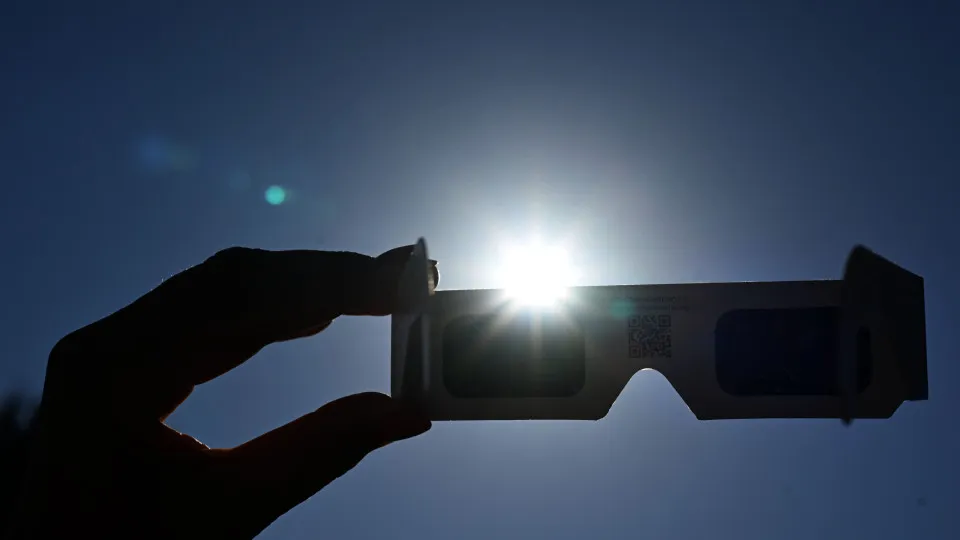
Anyone in regions where the eclipse will be visible should be careful and never look directly at the Sun without adequate protection. Ordinary glasses, cameras, binoculars and telescopes without specific filters do not protect the eyes.
In Spain, one of the main observation points, totality will occur with the Sun very low on the horizon, close to sunset. Therefore, a free vision in this direction will be necessary.
The duration of the total eclipse varies depending on the location, being longer for those close to the center of the totality band. Weather conditions will also be decisive for observation.
The 2026 eclipse begins a sequence of phenomena in the Iberian Peninsula. In August 2027, parts of Spain will be able to observe another total solar eclipse. In January 2028, it will be the turn of an annular solar eclipse.
In Brazil, it will be possible to follow broadcasts from NASA and the National Observatory. In the early hours of August 27th to 28th, a partial lunar eclipse can be seen across the country, if the sky is open.
Also Read: WhatsApp will stop working on Android 5 phones