MATHEUS ROCHASÃO PAULO, SP (FOLHAPRESS) - Gilberto Gil was an exiled man in the early years of the 1970s. After being arrested by the military dictatorship in 1968, the singer went into exile in London with Caetano Veloso, another exponent of tropicália detained in the same period. In the English capital, the musician came into contact with an effervescent artistic scene.
Musical tells how Gilberto Gil confronted the horror of repression with the beauty of art
MATHEUS ROCHASÃO PAULO, SP (FOLHAPRESS) - Gilberto Gil was an exiled man in the early years of the 1970s. After being arrested by the military dictatorship in 1968, the singer went into exile in London with Caetano Veloso, another exponent...
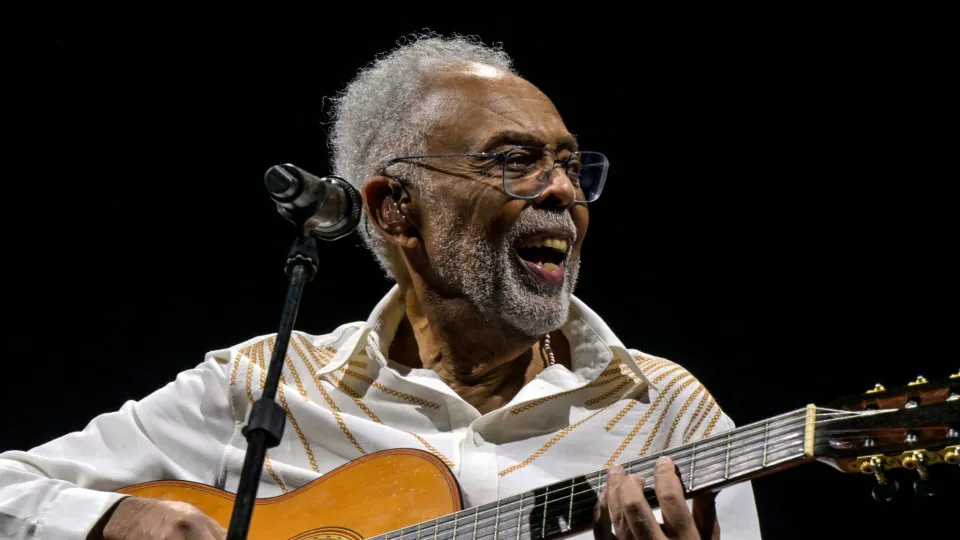
The musician emerged renewed from this cultural broth. In London, he bought his first guitar, a Gibson 335, an instrument with which he deepened the mix of Anglo-Saxon rock with the chords of Brazilian music.
- As he sings in "Back to Bahia", leaving was necessary so he could return.
- Not surprisingly, the musical "Gil - Andar com Fé" uses exile as a starting point to tell the origins of one of the most luminous names in Brazilian music.
Editorial reading aid based only on information contained in this story and its identified source.
The musician emerged renewed from this cultural broth. In London, he bought his first guitar, a Gibson 335, an instrument with which he deepened the mix of Anglo-Saxon rock with the chords of Brazilian music. As he sings in "Back to Bahia", leaving was necessary so he could return. Not surprisingly, the musical "Gil - Andar com Fé" uses exile as a starting point to tell the origins of one of the most luminous names in Brazilian music.
Directed by Miguel Falabella and starring Gui Ventura, the show premieres this Thursday, the 20th, at Teatro Santander, in the capital of São Paulo, to celebrate not just a man, but the spirit of a time.
"Conceptually, we needed to pay homage to a generation, a movement at the end of the 1960s that came with a foot in the door and saved us from absolute nonsense, from which there would be no way out", says Falabella. "No wonder they were massacred."
The tribute to this generation can be felt by the presence on stage of performers by artists such as Gal Costa, Caetano Veloso and Maria Bethânia. Alongside them, Gil formed the group Doces Bárbaros in 1976.
The scenography references the artistic avant-gardes that swept Brazil from the 1950s onwards. There are ramps installed on the stage, a scenic element that recalls the sinuosity of Lygia Clark's sculptures, and little flags, from Alfredo Volpi's paintings. The little flags set the scene for Gil's childhood in Ituaçu, a city in the interior of Bahia, where the artist took his first steps in music. It was there that he learned to play the accordion, at the age of 10, influenced by Luiz Gonzaga's baião.
Graduated in medicine, the artist's father left Salvador with his family due to the difficulty of practicing his profession in the capital. In the play, the character who plays Gil's father attributes the obstacles to racism.
The racial issue, in fact, reappears when the production shows Gil's trip to Lagos, Nigeria, in 1977. At the time, he came into contact with Fela Kuti's afrobeat.
This incursion inspired "Refavela", an album that incorporated rhythms such as reggae and juju music. "Aqui e Agora" and "Ilê Ayê" are some of the best-known tracks from this work.
The show portrays this dive into black cultures through a musical number that combines songs such as "Haiti", "Ladeira da Preguiça", "Babá Alapalá" and "Punk da Periferia".
"This segment is very beautiful because he sings these new rhythms, these new sounds", says Falabella, for whom the artist is part of a generation that revitalized Brazilian art. "No matter how much opposition they found in carelessness, they were a new wind that swept everything away."
The influence of African people can also be felt in the musical's narrative structure, a production that unfolds in a non-linear way. It is a practice that follows the Yoruba culture's interpretation of the world, a people for whom time is not a straight line, but a spiral that intertwines past, present and future.
Gil's journey is led by Time-Rei. The mythical character is played by Guga Barbosa and was inspired by a song by the artist. Throughout the narrative, it is as if this entity were a cicerone who guides the audience through the musician's biography.
It is a trajectory in which Gil used the subtlety of poetry to face the repression of the dictatorship. This can be felt in "Cálice", a partnership with Chico Buarque, which focuses on censorship through language games.
In 1973, the two tried to sing the song during an event in São Paulo. The artists, however, had their microphones turned off by military regime censors, an incident portrayed in the musical.
"For us artists, it's a lesson on how we should always represent the country and time through art", says Newton Moreno, playwright who wrote the play's text.
He decided to begin his dramaturgy in exile as a warning about the dangers of authoritarianism, a phenomenon that is gaining strength in several countries around the world. The playwright also included this passage to portray the artist at a borderline moment. "I wanted to take Gil's place of crisis. And it seemed to me that the crisis there was family, geographic and political."
In a way, the moments of vulnerability help to reveal the man behind the icon. This was one of Gui Ventura's objectives when playing the artist.
When building the character, he turned to African-based religions, for which the gods are not perfect and infallible. "When I deify Gil, it's like a deity close to human. A deity that makes mistakes, that has light and shadow."
Although he bears physical similarities to the artist, Ventura avoided a performance based on imitation. “I was thinking about how to compose this character without going too caricatured or burlesque,” ??says the actor. "The attempt to completely become Gil might not be the smartest."
Another moment that brings the artist closer to the public occurs when the musical makes reference to the end of his relationship with Sandra Gadelha, to whom he was married for just over a decade. The end of the marriage inspired "Drão", a song that talks about the persistence of affection even after the end of the marriage.
Ventura says he gets emotional when presenting this track because he considers that the song expands the concept of love. "He expresses there not the end, but the transformation of love. It is a love that is not petty."
For the actor, Gil also expanded the concept of musicality. "He took our music from one place and put it in a place of infinite possibilities. That continues today. Whether we like Gil's work or not, we are children of that attitude."
GIL - WALKING IN FAITH- When Thu. and Fri., at 8pm. Sat., 4pm and 8pm. Sun., 3pm and 7pm. Until October 11th - Where Teatro Santander - av. Pres. J