President Luiz Inácio Lula da Silva (PT) classified the discovery of oil off the coast of Amapá as a matter of national sovereignty and stated that Brazil will not accept external interference in the exploration of its reserves.
Lula says oil in Amapá 'means national sovereignty'
President Luiz Inácio Lula da Silva (PT) classified the discovery of oil off the coast of Amapá as a matter of national sovereignty and stated that Brazil will not accept external interference in the exploration of its reserves. The...
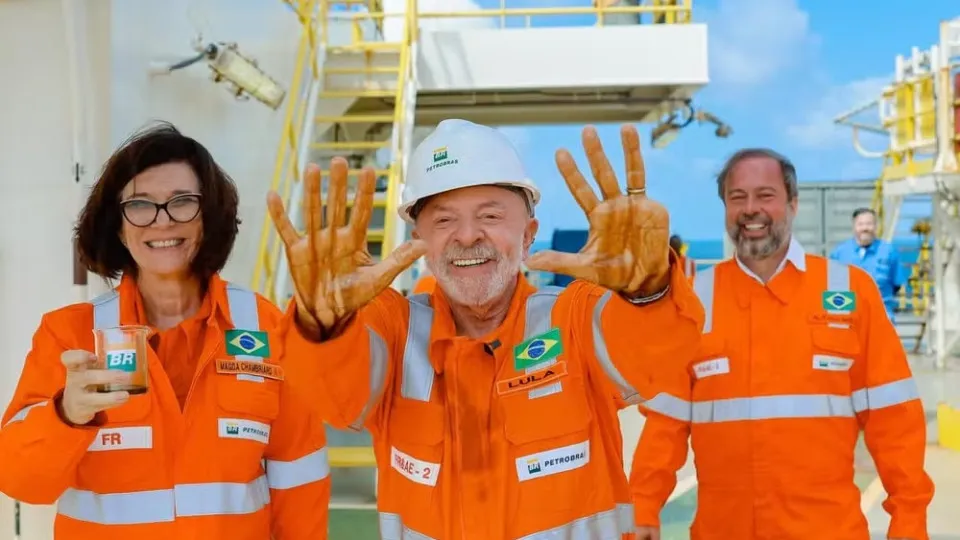
The president of the state-owned company, Magda Chambriard, also participated in the visit. A country that has oil of this quality will not allow anyone to put their finger on it," said Lula.
- When defending the advancement of research, the president maintained that the eventual exploration of the region could generate resources for investment in the country.
- "I'm thinking about the benefit this will give the country when we want to do more universities, more mathematics, more digital intelligence, more comprehensive schools and more investment...
Editorial reading aid based only on information contained in this story and its identified source.
The statement was made this Monday (17), during a visit to Petrobras' NS-42 probe, which is carrying out exploratory research in the Morpho well, in deep waters on the Equatorial Margin. The president of the state-owned company, Magda Chambriard, also participated in the visit.
"This means national sovereignty. A country that has oil of this quality will not allow anyone to put their finger on it," said Lula.
When defending the advancement of research, the president maintained that the eventual exploration of the region could generate resources for investment in the country.
"I'm thinking about the benefit this will give the country when we want to do more universities, more mathematics, more digital intelligence, more comprehensive schools and more investment in our sovereignty", he said.
'Passport to the future'
Lula also compared the importance of the discovery to the prospects opened up by the pre-salt and called the oil found a possible "passport to the future" of Brazil.
"This could be called a passport for the future of this country," said the president when presenting a sample of the oil removed during drilling.
The PT member highlighted, however, that defending oil exploration does not mean abandoning the energy transition.
"When I talk about a passport for the future of this country, I'm not denying my fight so that one day we don't need to use fossil fuels," he declared.
According to Lula, the country should continue investing in biofuels and other renewable sources while there is still global demand for oil.
The president also highlighted the characteristics of the oil found. When comparing the sample with pre-salt oil, he stated that the material from the Equatorial Margin "looked like it was already refined, it was so light."
Lula recalls pressure before COP30
During his speech, Lula spoke again about the resistance faced by the government in moving forward with oil research in the region.
The president stated that, before COP30, held in Belém in 2025, he received recommendations not to announce the obtaining of the environmental license because of the possible international reaction.
"A lot of people wanted me not to declare that I had won the license, because they said that the Europeans would be upset if we announced that we were going to look for oil", he stated.
Lula said that he decided to maintain the defense of prospecting because he considered that the interests of Brazil and Petrobras were at stake. At the same time, he promised that exploration will be accompanied by environmental protection measures.
"We will continue to take care of the environment," he said. The president also highlighted that a large part of Amapá's territory remains protected and covered by forest.
Petrobras is still evaluating the size of the discovery
Despite the government's celebratory tone, it is still not possible to say whether the discovery will allow commercial oil production.
The president of Petrobras, Magda Chambriard, confirmed the presence of the resource in the Morpho well, but highlighted that the volume still needs to be determined.
"There is oil and discovery, we still don't know how much, but we are extremely optimistic about what we are finding here," he stated.
Completion of drilling is expected to take place in approximately 15 to 20 days. Only with the advancement of studies will it be possible to better understand the potential of the area.
The Morpho well is located in block FZA-M-59, approximately 175 kilometers off the coast of Amapá, in an area with a water depth of 2,886 meters. Petrobras has a 100% stake in the block.
The state-owned company also requested authorization to drill three other wells in the same region. These new drillings still depend on the environmental licensing process and the results obtained at Morpho.
The search for new reserves has gained importance for Petrobras given the expectation that the pre-salt will reach its production peak around 2034 and 2035. The Equatorial Margin is considered one of the main exploratory frontiers for the replacement of Brazilian reserves in the coming decades.
'There is oil, but we don't know how much', says president of Petrobras about discovery in Foz do Amazonas
Petrobras confirmed the discovery of oil in the Morpho well, in the Foz do Amazonas Basin, on the coast of Amapá. The state-owned company is still evaluating the volume found and plans to complete the exploration of the well in the coming weeks