Humanoid robots may be just a few years away from a transformation capable of definitively bringing them into the daily lives of people and companies. The prediction is from Wang Xingxing, founder of Unitree, the largest Chinese robotics manufacturer, who estimates a period of between two and ten years for the sector to reach the so-called "ChatGPT moment".
Humanoid robots could experience 'ChatGPT moment' in up to 10 years, says CEO
Humanoid robots may be just a few years away from a transformation capable of definitively bringing them into the daily lives of people and companies. The prediction is from Wang Xingxing, founder of Unitree, the largest Chinese robotics...
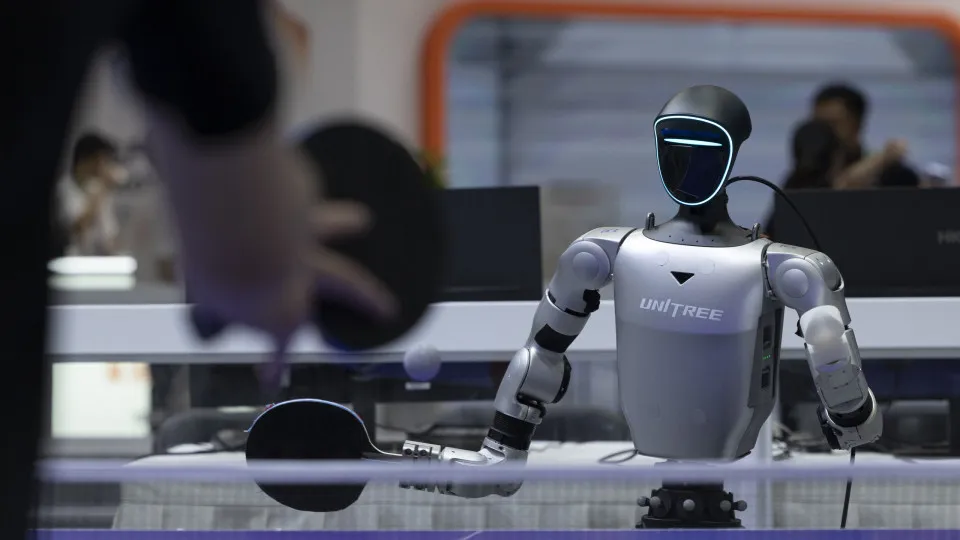
The expression refers to the impact caused by the launch of ChatGPT, at the end of 2022. In the technology sector, it began to be used to define the point at which an innovation stops occupying only specialized spaces and reaches sufficient maturity to be understood and adopted on a large scale.
- During the World Robotics Conference, held in Beijing, Wang explained that this stage will be reached when humanoids are able to perform around 80% of tasks in 80% of environments they have...
- The difficulty, according to the executive, lies precisely in making robots able to adapt to situations different from those for which they were trained.
Editorial reading aid based only on information contained in this story and its identified source.
The expression refers to the impact caused by the launch of ChatGPT, at the end of 2022. In the technology sector, it began to be used to define the point at which an innovation stops occupying only specialized spaces and reaches sufficient maturity to be understood and adopted on a large scale.
During the World Robotics Conference, held in Beijing, Wang explained that this stage will be reached when humanoids are able to perform around 80% of tasks in 80% of environments they have never previously encountered, just from instructions.
The difficulty, according to the executive, lies precisely in making robots able to adapt to situations different from those for which they were trained.
In controlled and repetitive spaces, systems fed with a large amount of data can reach close to 100% efficiency. Performance, however, drops when there are changes in the environment or in the objects that need to be manipulated.
This problem is related to so-called embedded intelligence, which combines artificial intelligence systems with machines capable of physically acting in the real world.
Jump may happen faster than expected
Wang considers that, in the most optimistic scenario, the change could occur within two or three years. If technological challenges take longer to overcome, the deadline could reach five or ten years.
The businessman highlighted, however, that the current pace of development of artificial intelligence can accelerate this process and make humanoid robots advance faster than the sector itself expects.
Unitree focuses a large part of its AI team precisely on this challenge. The company works to expand the ability of robots to perform real-world activities in homes and factories.
The company also maintains partnerships with car manufacturers to test equipment on production lines, one of the environments considered strategic for the commercial adoption of the technology.
Unitree debuts on the Shanghai Stock Exchange
Wang's statements come in the same week that Unitree hit the mainland Chinese stock market. On Wednesday, the manufacturer debuted on the Shanghai Stock Exchange and raised the equivalent of US$904 million.
The listing was met with great interest from investors. Demand for shares was more than eight thousand times greater than the quantity of shares offered for sale.
At debut, the titles were worth more than seven times their initial price. The appreciation led the company to reach a valuation of approximately US$66 billion.
The move also boosted 36-year-old Wang's fortune to close to $16 billion.
At the end of the first trading session, Unitree shares rose 460%. This Thursday, however, the shares fell more than 16% around 11:30 am local time, in a movement towards profit taking by investors.
The Beijing World Robotics Conference continues until Sunday and brings together more than 3,000 products presented by more than 300 companies. Humanoid robots are among the main attractions of this edition.
Video shows Chinese robot that jumps 2 meters and runs faster than Usain Bolt
Video released by Unitree shows the model nicknamed “Superman” jumping more than two meters and reaching 12.66 meters per second. The Chinese manufacturer claims that the robot was developed in just over three months and can still evolve.