(FOLHAPRESS) - "I don't know what I'm going to do without you, I don't know how to go on."
Former metalworker, Messi's father became a businessman to manage his son's career
(FOLHAPRESS) - "I don't know what I'm going to do without you, I don't know how to go on." Lionel Messi's phrase in his father's farewell letter, who died at the age of 68 on August 8, for reasons not disclosed by the family, shows the...
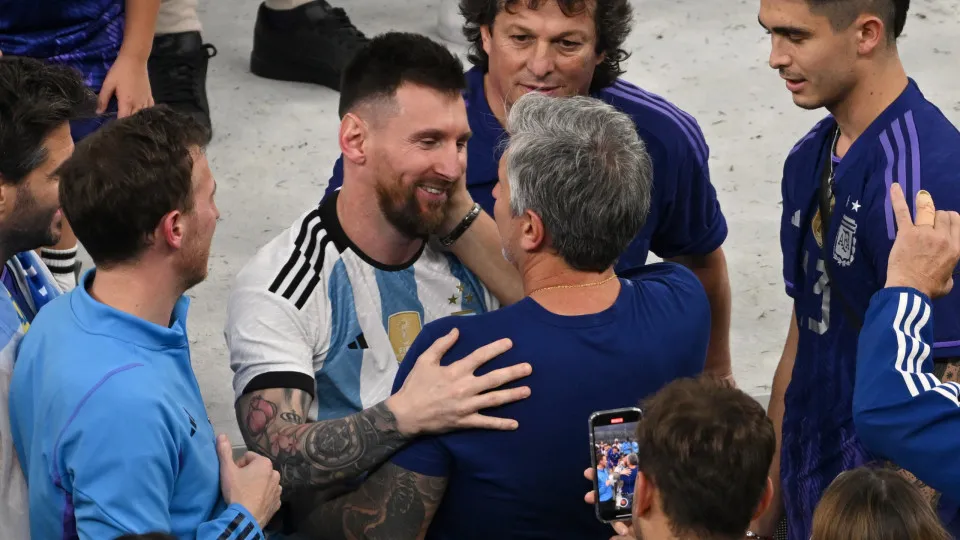
"He was always by my side, from the beginning," the Argentine wrote on his social networks last Wednesday (12). "You took me to every training session as soon as you got home from work." The professional history of the athlete, eight-time Ballon d'Or winner, three-time Champions League champion and second highest scorer in the history of World Cups,...
- "You took me to every training session as soon as you got home from work." The professional history of the athlete, eight-time Ballon d'Or winner, three-time Champions League champion and...
- Just like Messi, who fell in love with his wife, Antonela Roccuzzo, when he was nine years old, Jorge met the mother of his children, Celia, when he was still a child.
- In 1987, when the player, the third of the couple's four children, was born in Rosario (300 km from Buenos Aires), he was a section head at the Argentine steel company Acindar.
Editorial reading aid based only on information contained in this story and its identified source.
Lionel Messi's phrase in his father's farewell letter, who died at the age of 68 on August 8, for reasons not disclosed by the family, shows the importance of Jorge Messi in his son's life, who called into question his continuity in football when talking about the loss.
The star, who defined the businessman as "father, friend and representative", says that now he doesn't know if he will continue in the sport "for much longer". "He was always by my side, from the beginning," the Argentine wrote on his social networks last Wednesday (12). "You took me to every training session as soon as you got home from work."
The professional history of the athlete, eight-time Ballon d'Or winner, three-time Champions League champion and second highest scorer in the history of World Cups, necessarily goes through his father, a metalworker who reinvented himself to be at the forefront of his son's career.
Just like Messi, who fell in love with his wife, Antonela Roccuzzo, when he was nine years old, Jorge met the mother of his children, Celia, when he was still a child. In 1987, when the player, the third of the couple's four children, was born in Rosario (300 km from Buenos Aires), he was a section head at the Argentine steel company Acindar.
Reports about that time in the Argentine press show that his life differed little from that of any other worker in the region: he took a bus, charter or ride with colleagues to get to the company in Villa Constitución, 60 km from Rosario, where he worked 12 hours a day. In his free time, he accompanied his sons Rodrigo and Matías, who were already taking risks in the field.
Daniel Ángel Reche, a colleague of Jorge's at that time, described the metalworker to Argentine broadcaster Todo Noticias as "discreet, very hardworking, always willing to help and an excellent colleague".
Messi's abilities would come to light when he was four years old, after receiving a ball as a birthday gift from his parents. "We were paralyzed seeing what he knew how to do", Jorge told Luca Caioli, as the Italian journalist recorded in his biography "Messi: The Boy Who Became Legend" (L&PM Editores, 2014). "He had never played before."
His father was one of the player's first coaches at Grandoli, a club that was a few blocks from the family home in Rosário. It wasn't his first adventure in football: the Argentine played as an amateur for Newell's, his family's favorite team, located in the same city, until he needed to do his military service, according to Caioli.
"When I played, I loved football," Jorge told his son's biographer. "I got up and went to sleep thinking about football. Maybe I passed that on to Leo."
Newell's was Messi's home from 1994 to 1999, a period in which the family discovered a health problem in the boy that would change his professional trajectory and, consequently, Jorge's.
A growth hormone deficiency caused the nine-year-old boy to grow slower than expected for his body height. The issue was the price of the treatment: approximately US$14,000 per year, at a time when a deep economic crisis was impacting steel companies in Argentina.
"It wasn't difficult for me to transfer to Barcelona because I knew what I needed. I needed money for my medicines that would help me grow, and Barcelona was the only club that offered me. So, as soon as they made me the offer, I knew I had to go", said Messi in 2010 to the British newspaper The Guardian.
The player and his father left Rosario for Spain in September 2000, when the future football star was 13 years old.
Messi would remember this move as one of the most difficult moments of his life. "I left my city, my friends, my people. The first months here were very difficult. There were times when my father and I were in Barcelona and the rest of the family in Rosario. We suffered. I missed Matías, Rodrigo, my sister, my mother. I cried alone, in my house, so that my father wouldn't see me", he said to Caioli.
Months after the boy's arrival in the Spanish city, the family decided to split up: Rodrigo and Matías would accompany their father and brother; Celia and her sister, María Sol, would stay in Rosário. In Europe, Jorge took the lead in negotiations involving his son's career, even though he had no experience in it.
The story is common: Neymar's father is the Brazilian player's manager; Kylian Mbappé's also manages his son's career. However, Jorge is one of the most famous examples of this type of family management in football. He completely took over his son's representation around 2001 and, at the end of the 2000s, he was the agent of the greatest football player of a generation, negotiating million-dollar contracts with the main clubs in the world.
Messi himself admitted that he did not read his contracts in 2016, after he and his father were accused by Spanish courts of evading taxes on the player's image rights through companies abroad.
"I don't look at what I sign. If my father says I should sign, I sign with my eyes closed. I don't focus on it, I don't ask questions," said the star during a trial, which ended with fines and no prison time. "My son doesn't know how to make money," said his father in the same process.
Due to his health, Jorge did not accompany his son to the last World Cup. Messi was runner-up for Argentina in the United States. He died in Rosario, his hometown.
"It was the first time he wasn't in a championship," said the star in his farewell letter. "Every time I finished a game, I waited and missed a message from you. Then I realized that the situation was really complicated."
New rules against wax increase ball rolling time in Brasileirão
New rules against wax increased the average time the ball was rolling by around 5% in the first nine games of the 23rd round of the Brasileirão. The average went from 52min54s to 55min29s, according to the CBF