Millions of people flocked to cities and towns in Spain on Wednesday, 12th, looking for the best places to observe the total solar eclipse, when the alignment of the Sun, Moon and Earth briefly plunged parts of the planet into darkness.
Solar eclipse was witnessed in Russia, Spain, Greenland, Iceland and part of Portugal
Millions of people flocked to cities and towns in Spain on Wednesday, 12th, looking for the best places to observe the total solar eclipse, when the alignment of the Sun, Moon and Earth briefly plunged parts of the planet into darkness....
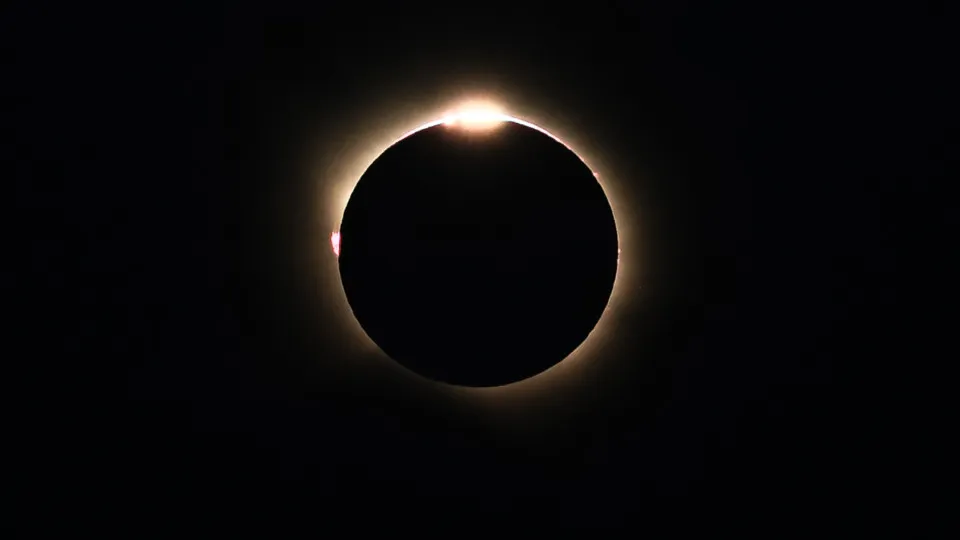
It was the country's first total solar eclipse in more than a century. The phenomenon was seen in its entirety in Russia, Spain, Greenland, Iceland and a part of Portugal.
- According to NASA, the band of totality began in more remote areas, such as northern Siberia, close to the North Pole, and will then pass through the Arctic and North Atlantic oceans before...
- The total phase began at 1:58 pm, and the maximum point of the eclipse occurred at 2:46 pm.
Editorial reading aid based only on information contained in this story and its identified source.
Crowds carried beach chairs, umbrellas and hats as they eagerly awaited the celestial spectacle, which began in the early evening. It was the country's first total solar eclipse in more than a century. The phenomenon was seen in its entirety in Russia, Spain, Greenland, Iceland and a part of Portugal.
According to NASA, the band of totality began in more remote areas, such as northern Siberia, close to the North Pole, and will then pass through the Arctic and North Atlantic oceans before reaching Iceland and Spain. The total phase began at 1:58 pm, and the maximum point of the eclipse occurred at 2:46 pm.
In Brazil, the phenomenon was not seen from any part of the country, not even partially. However, the National Observatory carried out a live broadcast on YouTube.
According to the Time and Date website, around 980 million people live in areas affected by a partial or total eclipse. Of these, about 15.2 million people live along the totality band.
Total visible in 5 countries and partial in other areas
The band of totality began in far northern Russia, crossed Greenland and the western edge of Iceland, and then ran across northern and eastern Spain and part of the northeast corner of Portugal.
In some parts of Europe, the Moon appeared to "take a bite" of the Sun, slightly decreasing its brightness. The partial eclipse was also visible across northern North America.
According to the Time and Date website, before 2026, the last time the Moon completely covered the Sun was during the total solar eclipse that crossed Mexico, the United States and Canada on April 8, 2024.
When will the next solar eclipses be?
Total or annular solar eclipses happen on Earth on average once a year, but they cover very restricted areas of the planet, which gives the impression that they are rare phenomena.
- Annular Eclipse of the Sun on February 6, 2027: the visibility range of the annular eclipse will be over the sea, touching the extreme eastern coast of the State of Rio de Janeiro. The eclipse will be seen as partial in almost all of Brazil, except the extreme northwest;
- August 2, 2027: The world's next total solar eclipse will cross southern Spain, northern Africa and Saudi Arabia. It is being talked about a lot right now because of its duration, which will be 6min23sec. The longest total eclipse of the 21st century was that of July 22, 2009, which lasted 6min 39sec.
The longest duration of a solar eclipse is 7 minutes and 30 seconds. The longest-lasting eclipse until the year 3000 will occur on July 16, 2186, lasting 7 minutes and 29 seconds, which will be visible in South America to the north of Brazil and will not be visible in Brazil.
- August 12, 2045: The next total solar eclipse visible in Brazil will have its band of totality crossing states in the North and Northeast regions and partiality in the rest of the country.
Read Also: Solar eclipse will darken the sky for 15 million people around the world